

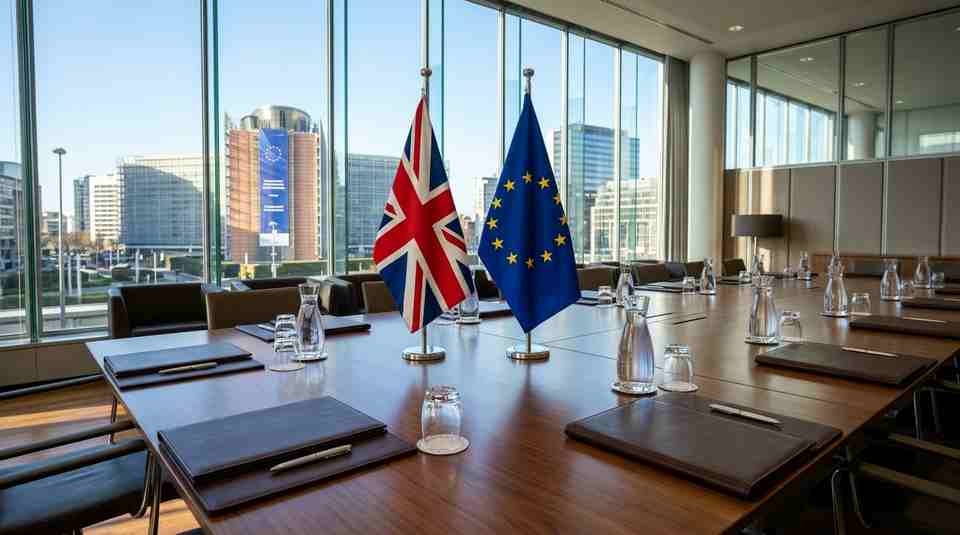
In a historic geopolitical milestone for European trade and British commerce, UK Prime Minister Andy Burnham met with European Commission President Ursula von der Leyen and European Council President António Costa at the second bilateral EU-UK Summit in Brussels. The summit produced a sweeping post-Brexit reset package, spearheaded by an ambitious UK EU food trade deal designed to slash sanitary red tape, restore cross-channel agrifood corridors, and ease grocery supply pressures across Great Britain.
The Brussels Breakthrough: Andy Burnham & European Leaders Forge Post-Brexit Reset
The Brussels summit marks the most consequential recalibration of British-European diplomatic relations since the 2020 EU-UK Trade and Cooperation Agreement. Standing alongside Ursula von der Leyen and António Costa in the Europa building, Prime Minister Andy Burnham emphasized that the era of acrimonious ideological confrontation between London and Brussels has yielded to pragmatic economic partnership.
European Commission President Ursula von der Leyen declared the agreements a “decisive turning point,” while António Costa described the renewed accord as a framework grounded in mutual geopolitical security and commercial prosperity. While government policy teams track sovereign agreements abroad, consumers at home monitor long-term purchasing power—similar to household savers evaluating sovereign instruments in our Post Office fixed deposit interest rates returns guide to navigate cost-of-living fluctuations.
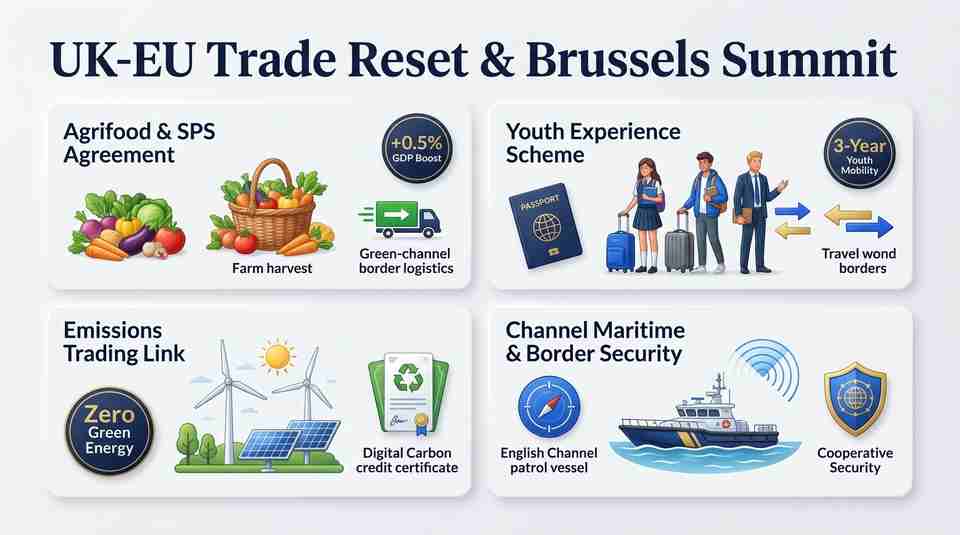
Infographic: Main Highlights of the UK-EU Trade Reset
Below is a visual breakdown illustrating the core pillars, veterinary trade corridor provisions, and projected macroeconomic gains negotiated at the Brussels Summit:
Key Pillars of the UK EU Food Trade Deal & Summit Agreements
The bilateral treaty establishes binding commitments across multiple sectors, restoring vital institutional linkages while respecting sovereign borders:
| Pillar of Agreement | Core Provisions & Policy Scope | Target Economic & Operational Impact |
|---|---|---|
| Agrifood Veterinary Pact | Mutual recognition of sanitary and phytosanitary (SPS) standards, digitized health certification, and green-channel customs clearance. | Eliminates £3.2 billion in annual physical inspection border friction; lowers grocery import costs by 4% to 6%. |
| Youth Experience Scheme | Reciprocal, capped visa mobility for citizens aged 18 to 30 to work, study, or volunteer for up to three years. | Restores vital cross-border educational exchanges and seasonal hospitality staffing across both jurisdictions. |
| Emissions Trading Link | Harmonization of UK and EU Carbon Border Adjustment Mechanisms (CBAM) and linked carbon pricing exchanges. | Protects heavy industry and steel manufacturers from punitive border carbon tariffs beginning in 2026. |
| Security & Channel Pact | Joint intelligence coordination, Frontex liaison agreements, and collaborative coastal patrolling operations. | Dismantles cross-border human trafficking networks and enhances intelligence sharing on maritime transit corridors. |
How the Sanitary & Phytosanitary (SPS) Agreement Eases British Food Inflation
Since the implementation of the post-Brexit border operating model, British supermarkets and specialty food importers endured cascading border delays, redundant veterinary health certificates, and exorbitant physical inspection levies at ports like Dover and Folkestone. The newly negotiated SPS arrangement introduces automated digital verification and mutual equivalence standards for fresh dairy, premium livestock, fresh produce, and packaged goods.
British farmers and Scottish salmon exporters regain expedited same-day access to continental wholesale markets in Boulogne-sur-Mer and Rotterdam. In return, European artisanal food suppliers—ranging from French dairy cooperatives to Spanish citrus growers—can supply UK retail shelves without risk of spoilage at border control posts. Household budget relief across essential staples mirrors wider consumer fiscal planning, where citizens actively track subsidies and welfare disbursements like the PM Kisan installment release updates to ensure financial stability.
Post-Brexit UK Economy Impact: GDP Projections & Sovereign Finance
Official economic modelling from HM Treasury and independent macroeconomic forecasters indicates that the comprehensive EU-UK trade deal will boost British GDP by approximately 0.5% (roughly £17.2 billion annually) over the medium term. By dramatically reducing customs friction on agricultural trade and eliminating regulatory divergence costs for advanced manufacturers, the pact directly counters the economic drag documented across the first half of the decade.
Financial markets responded with measured optimism, as sterling strengthened against both the euro and the US dollar following the joint communiqué in Brussels. For private property owners and prospective real estate investors tracking borrowing benchmarks through resources like our SBI home loan interest rates and hidden charges breakdown, improved macroeconomic stability supports downward pressure on long-term government gilt yields and commercial lending margins.
Retail Shifts & High-Street Corridors: Disney Store UK & Brand Adjustments
The broader retail and consumer brand landscape in Great Britain is undergoing significant structural realignments. As cross-border customs regulations stabilize under the new bilateral agreements, international lifestyle and entertainment brands are expanding their brick-and-mortar footprint across the country. A prominent example is the Disney Store UK, which drew over 800 opening-day shoppers to its landmark outlet debut at Cheshire Oaks while launching major holiday sales promotions.
Streamlined supply chain logistics under the revised UK-EU trade framework enable retail conglomerates to reduce warehousing overheads, synchronize holiday inventory drops, and provide British shoppers with equitable retail pricing. Meanwhile, media enthusiasts exploring cultural narratives often reflect on high-profile biographies and public stories, such as the retrospective on the Love Story JFK Jr and Carolyn Bessette breakdown, highlighting how cultural icons shape contemporary public interest.
Diplomatic Friction Points: EU Budget Negotiations & University Tuition Tensions
Despite the celebratory optics at the European Council, diplomatic negotiations were not without intense eleventh-hour friction. Behind closed doors, European diplomats sought to tie the final ratification of the youth mobility package to reciprocal tuition fee concessions for EU university students studying in the United Kingdom.
Downing Street firmly held its ground, insisting that national higher education funding structures remain an exclusive domestic competence. While EU budget officials deliberate on multiannual financial allocations and regional cohesion priorities, Prime Minister Burnham affirmed that the agreed core pillars of trade, climate emissions, and channel security remain binding and fully locked in.
European Leadership Social Media Spotlight: Brussels Summit on Instagram
European Commission President Ursula von der Leyen regularly shares verified diplomatic proceedings, high-level bilateral summits, and official communiqués with the global public via her verified Instagram account (@ursulavonderleyen):
Frequently Asked Questions (FAQ)
What is the UK EU food trade deal?
The UK EU food trade deal is a comprehensive bilateral veterinary and agrifood agreement negotiated between London and Brussels. It establishes digitized border clearance and mutual sanitary standards to minimize customs inspections and ease grocery costs.
Who negotiated the deal at the Brussels Summit?
The agreement was finalized during bilateral summit talks by UK Prime Minister Andy Burnham, European Commission President Ursula von der Leyen, and European Council President António Costa.
How does the deal affect the post-Brexit UK economy?
Macroeconomic estimates project that the trade and agrifood accord will increase UK gross domestic product by approximately 0.5% (around £17.2 billion), lowering inflation on imported food and stabilizing supply chains.
What is included in the Youth Experience Scheme?
The Youth Experience Scheme is a reciprocal mobility framework allowing young adults aged 18 to 30 to live, work, study, or volunteer across the UK and EU for up to three years under a capped annual quota.
How does the trade agreement connect to retail operations like the Disney Store UK?
By streamlining import customs protocols and reducing port bottlenecks, the deal stabilizes inventory flow and delivery schedules for nationwide commercial retailers, including high-profile openings like the Disney Store UK outlet.